
Frugal living should make your home easier to run—not turn every purchase into a guilt trip. I use a simple rule: cut the costs that repeat, keep the things that genuinely improve daily life, and repair small leaks before they become expensive problems.
These frugal living tips give you a practical starting system for groceries, household bills, maintenance, family spending, and the routines that quietly drain a budget. You do not need to overhaul everything this weekend. Pick the area with the clearest payoff, make one change, and let the savings fund the next one.
This post contains affiliate links. If you buy through our links, we may earn a commission at no extra cost to you. As an Amazon Associate, I earn from qualifying purchases. Learn more.
Table of Contents
- Find Your Best First Move
- The 15-Minute Frugal Home Reset
- What Frugal Living Actually Means
- Build a Budget That Protects Your Household
- Spend Less on Food Without Making Life Harder
- Lower Home Costs Before Buying More
- Cheap Living for Seniors: Low-Stress Ways to Save
- Make Everyday Spending Easier to Control
- Use a Better Buy-or-Skip Rule
- A 30-Day Frugal Living Plan
- Frequently Asked Questions
- Start With the Leak You Can See
Not sure which section deserves your attention first? The five-question check below points you to the part of the guide most likely to produce a useful win.
Find Your Best First Move
Answer five quick questions to find your easiest household saving opportunity. This is a starting-point tool, not a judgment of how “good” you are with money.
The 15-Minute Frugal Home Reset
The fastest way to begin is not to hunt for fifty clever hacks. It is to stop one recurring leak and create one visible next action. Set a timer for 15 minutes and work through this order:
- Find one automatic charge. Cancel it, pause it, or write down why it still earns its place.
- Plan three dinners from food you already own. Put the ingredients where you will see them.
- Check one home trouble spot. Look under a sink, around a drafty door, or at the HVAC filter.
- Move one amount automatically. Even a modest transfer creates a repeatable saving habit.
- Write tomorrow’s one-minute task. Frugal systems survive because the next step is obvious.
Do this now: Choose just one line above. A finished small fix is more useful than a perfect plan you never start.
What Frugal Living Actually Means
Frugal living is the habit of directing money toward what matters and reducing the cost of everything that does not. It is not the same as buying the cheapest version of every item, avoiding every convenience, or turning ordinary life into a constant restriction challenge.
| Decision | Cheap approach | Frugal approach |
|---|---|---|
| Replacing something | Buy the lowest-priced option immediately. | Repair first, compare total lifespan, then buy only if replacement wins. |
| Hiring help | Avoid paying anyone, even when the risk is high. | DIY the safe, learnable work and hire when mistakes could cost more. |
| Using time | Spend hours to save a tiny amount. | Protect time for changes that repeat or prevent a larger bill. |
| Keeping possessions | Keep everything because replacing it might cost money. | Keep useful items, sell or donate clutter, and maintain what remains. |
I find this question more useful than “Is it cheap?”: Will this choice lower the total cost of running the household without creating a bigger problem? That test works for groceries, furniture, repairs, subscriptions, and almost every DIY decision on this site.
Use a three-part decision rule
- Can I use, repair, borrow, or repurpose what I already have?
- If I spend money, will the result save time, prevent damage, or get used often?
- What is the stop condition? Decide in advance when a DIY job, bargain hunt, or repair attempt is no longer worth continuing.

Build a Budget That Protects Your Household
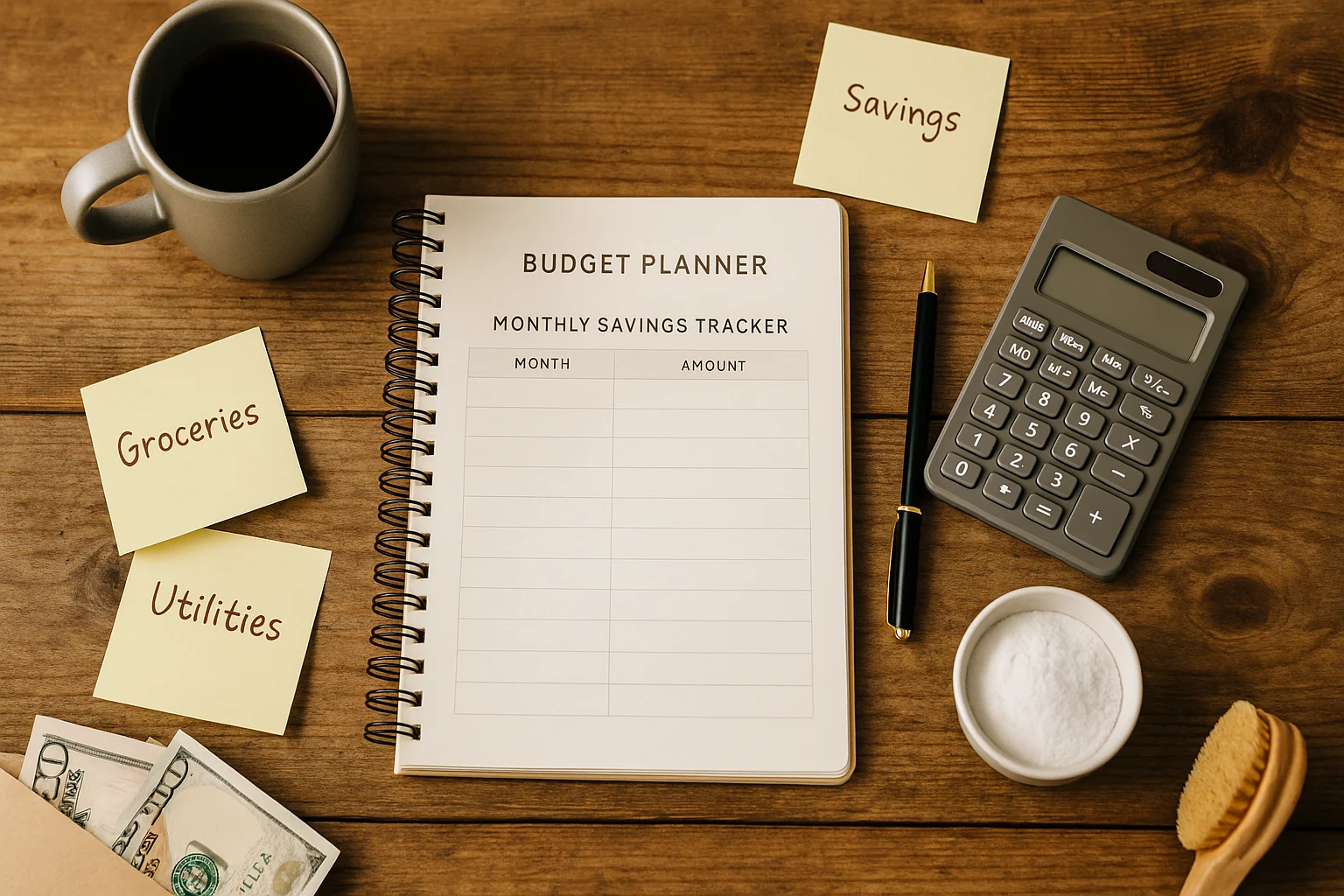
A useful budget does not need dozens of categories. It needs to show what must be paid, what changes month to month, and what you are protecting next. Start with four lines:
- Income: take-home money that actually reaches the household.
- Fixed commitments: housing, insurance, minimum debt payments, and recurring services.
- Flexible essentials: groceries, utilities, transport, home supplies, and pet costs.
- Future protection: emergency savings, repairs, annual bills, and planned goals.
For free federal worksheets and planning tools, browse MyMoney.gov’s money tools. The point is not to use the fanciest template; it is to make the next decision visible.
Start an emergency fund with a real definition
“Save more” is too vague to guide a household. Define what the fund is for: a broken appliance, urgent car repair, medical copay, temporary income loss, or another specific shock. The Consumer Financial Protection Bureau’s emergency-fund guide emphasizes creating a savings habit and choosing an amount that fits your situation rather than treating one number as universal.
Begin with a reachable first target, automate the transfer, and keep the money somewhere separate from everyday spending. Once the first target is complete, raise it based on the risks your household actually faces.
Give irregular bills a monthly home
Annual insurance, car registration, school costs, holiday spending, tax-preparation costs, and home maintenance are predictable even when they are not monthly. Divide the expected total by the number of months left and set that amount aside. Before paying for filing software, check the current no-cost options in the guide to avoiding tax-filing fees. This is often the difference between an “unexpected” bill and a planned one.
Use windfalls to remove future pressure
A refund, bonus, gift, or side-income month can disappear into normal spending. Decide the split before it arrives. One part can solve a current need; another can reduce debt or build the repair fund.
Spend Less on Food Without Making Life Harder
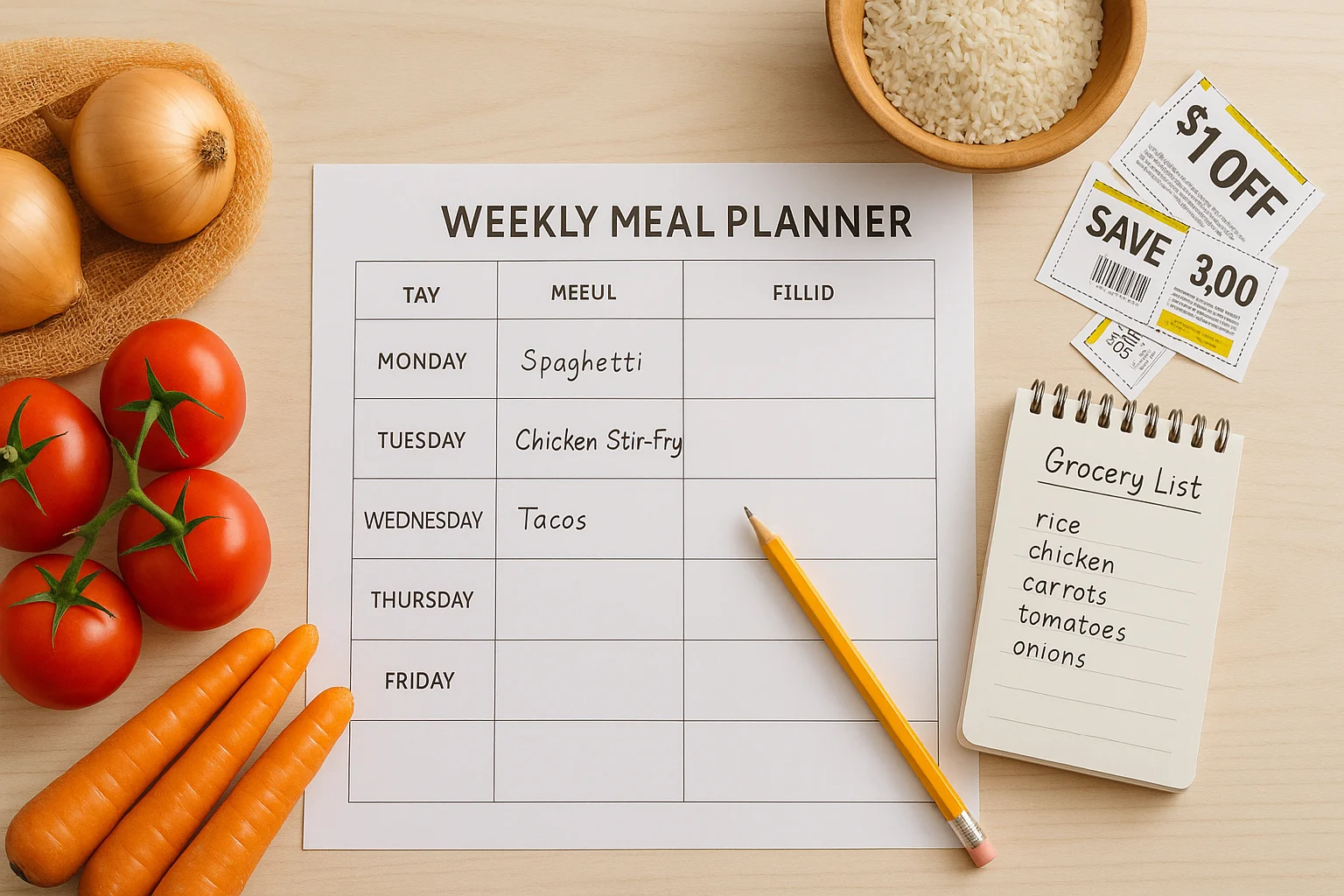
Food savings usually come from a better household system, not from chasing every coupon. Thrifty meal planning and sensible DIY-versus-buy savings both begin with knowing what your household will actually use. The sequence is simple: plan around what you already have, buy only what the plan needs, make the food easy to see, and create a backup meal for the night when cooking falls apart.
Plan from the kitchen outward
- Check the fridge, freezer, and pantry before choosing meals.
- Pick three or four dinners that share ingredients.
- Add one very easy backup meal.
- Write the list by store section so you are less likely to wander.
- Choose one “eat first” shelf or bin for food that needs attention.
For a complete weekly workflow, use the frugal meal-planning guide. For store-level tactics such as unit pricing and sale traps, see these smart grocery-shopping strategies.
Measure waste before blaming prices
The U.S. Environmental Protection Agency estimates that the average family of four spends almost $3,000 per year on food that is never eaten. Your household may be higher or lower, but the useful lesson is the same: buying less of the food you discard can beat finding a slightly cheaper version of it.
For one week, write down what gets thrown away and why. “Forgotten,” “cooked too much,” “nobody liked it,” and “takeout replaced the plan” each need a different fix.
Use a meal-planning app only when the list needs to be shared
A paper list is enough for one person. An app earns its place when several people need the same meal plan and grocery list, meal ideas are the bottleneck, or the plan keeps disappearing between shopping trips.
For families who need one shared plan
Little Lunches combines family meal ideas with a shared grocery list. It fits best when children are part of the meal-planning challenge; skip it if a basic one-person checklist already works.
View for Android View for iPhone
Annual-plan discounts and eligibility can change; check the partner page for current terms.
Whether you use an app or paper, keep the plan visible and simple enough to repeat next week. The system matters more than the tool.
Lower Home Costs Before Buying More
If you want to save money at home, start with the costs created by wasted energy, neglected maintenance, duplicate supplies, and items that are replaced instead of repaired. Start with diagnosis. A useful home-saving order is:
- Notice: find the draft, leak, clutter point, recurring mess, or failing part.
- Measure: check size, frequency, condition, or usage before buying a solution.
- Try the lowest-risk fix: clean, tighten, seal, maintain, or reorganize.
- Stop when the risk changes: electrical hazards, structural problems, mold, major water intrusion, and unsafe heights are not “save at any cost” jobs.
Start with energy and comfort leaks
Check weatherstripping, door sweeps, filters, thermostat schedules, and devices that stay on without a reason. ENERGY STAR’s home energy guidance organizes improvements around energy use, comfort, and high-impact upgrades. Use it to verify the right fix before buying equipment or materials.
Measure before replacing: HBN Plug-in Watt Meter.
Use it to check watts, kilowatt-hours, voltage, current, and running cost for one plug-in device. It works best as a diagnostic tool rather than a whole-home dashboard.
Use the reading to decide whether a schedule or habit change solves the problem before replacing the device.
Maintain before replacing
Create a short seasonal list instead of a giant home-maintenance binder. Include filters, visible plumbing connections, smoke and carbon-monoxide alarms, gutters or drainage where accessible, caulk and weatherstripping, and the condition of frequently used tools and appliances. The list should be small enough that you actually repeat it.
Clean with fewer products
Before adding another bottle, match the cleaner and method to the surface. A compact set of reusable supplies often handles more jobs than a cupboard full of single-purpose products. The frugal cleaning guide shows where homemade or reusable approaches make sense and where surface-specific caution matters.
Furnish slowly and repair first
Measure the room, identify the actual missing function, and wait for the right item instead of filling an empty corner quickly. Used furniture, simple repairs, and hardware changes can stretch a budget, but a “bargain” that does not fit or cannot be cleaned safely is not a saving. Use the room-by-room frugal furnishing guide before replacing a usable piece.

Cheap Living for Seniors: Low-Stress Ways to Save
For seniors on a fixed income, useful savings should reduce stress without sacrificing comfort, safety, or independence. The best changes are usually recurring and easy to maintain:
- Ask utility providers, local agencies, insurers, pharmacies, and transit systems about current eligibility-based discounts.
- Put renewal dates and annual bills on one visible calendar.
- Use simple meals built around familiar, easy-to-store ingredients.
- Review subscriptions and automatic renewals with a trusted family member or friend.
- Borrow or rent rarely used tools, but do not postpone a safety repair to avoid asking for help.
Keep the system simple: one page of dates, phone numbers, and recurring bills is usually more useful than a complicated app nobody wants to open.
Make Everyday Spending Easier to Control
Big financial decisions matter, but ordinary household routines decide whether the plan survives. Instead of relying on willpower, change the default.
Give the family visible rules
Choose two or three household rules everyone can understand: check the meal plan before ordering food, add requested purchases to a shared list, and wait a day before buying non-essential items over an agreed amount. The guide to frugal living with kids has age-appropriate ways to involve children without turning money into a source of fear.
Build pet costs into the real budget
Food, routine care, medication, grooming, and emergency planning belong in the household budget from the beginning. Prevention can reduce avoidable problems, but pet health decisions still need qualified veterinary guidance. The frugal pet-care guide separates sensible at-home savings from situations where delaying care can cost more.
Use a replacement rule for clothes and household goods
Before replacing something, check whether it can be cleaned, repaired, altered, or used differently. Then compare the time and material cost with a replacement that will genuinely last. This keeps “DIY” from becoming a project pile and keeps “new” from becoming the automatic answer.
Check Free Options First—Then Verify the Details
Libraries, community groups, tool-lending programs, local events, and neighborhood exchanges can solve many short-term needs. The frugal freebies guide is a starting point, but verify dates, eligibility, and pickup terms before planning around an offer.
Review subscriptions on a schedule
Do not wait until the budget feels tight. Review recurring services quarterly and ask three questions: Did we use it? Would we buy it again today? Is there a cheaper way to get the same result? Pause or cancel anything that fails two of the three.
Use a Better Buy-or-Skip Rule
A strong thrifty lifestyle is not built on constant self-denial. It is built on fewer, clearer decisions. Try this four-part filter:
- Use: Will this be used often enough to justify the space and cost?
- Replace: What current item or expense does it remove?
- Maintain: What will it cost in supplies, storage, subscriptions, or repairs?
- Exit: Can it be returned, resold, canceled, or stopped without a larger loss?
Motivation helps, but a reminder works only when it points to a behavior. Use these budgeting habit quotes as prompts, then attach each one to a real action such as checking the pantry, moving money, or completing a maintenance task.
Borrow before you buy; buy before you struggle
Borrowing is ideal for a one-time tool or temporary need. Buying can be smarter when the item will be used repeatedly and the borrowed version is unavailable, unsafe, or inconvenient enough to stop the job. Frugality is not a rule that borrowing always wins; it is a comparison of total cost and practical use.
Protect your time from tiny savings
Driving across town to save a small amount, maintaining a complicated coupon system, or repairing an item with no realistic life left can consume more value than it creates. Set a time limit for bargain hunting and a spending limit for experiments.
A 30-Day Frugal Living Plan
This plan is intentionally small. Each week creates one repeatable household system rather than a burst of cuts that disappear next month.
| Week | Focus | Finish line |
|---|---|---|
| 1 | Money visibility | List fixed bills, cancel or pause one weak recurring charge, and automate one transfer. |
| 2 | Food flow | Plan three dinners, create an “eat first” area, and record what gets wasted. |
| 3 | Home costs | Complete one maintenance check and one no- or low-cost efficiency fix. |
| 4 | Household rules | Agree on two spending rules and choose the next bill or repair fund to build. |
Keep one number: record the monthly amount you expect the new systems to free up. Move that amount toward a repair fund, emergency savings, or debt so the result does not dissolve into ordinary spending.
Frequently Asked Questions
Start With the Leak You Can See
You do not need to become a different person to practice frugal living. You need one household cost you can see, one action that reduces it, and one place for the savings to go. Start with the result from the check above or the 15-minute reset, finish that task, and let the next decision wait until tomorrow.
The goal is not to spend the least. It is to make your home less expensive to run, easier to maintain, and better aligned with the life you are already trying to build.
This article is educational and does not provide individualized financial advice. Consider your household’s needs and seek qualified help before major financial or high-risk home decisions.