
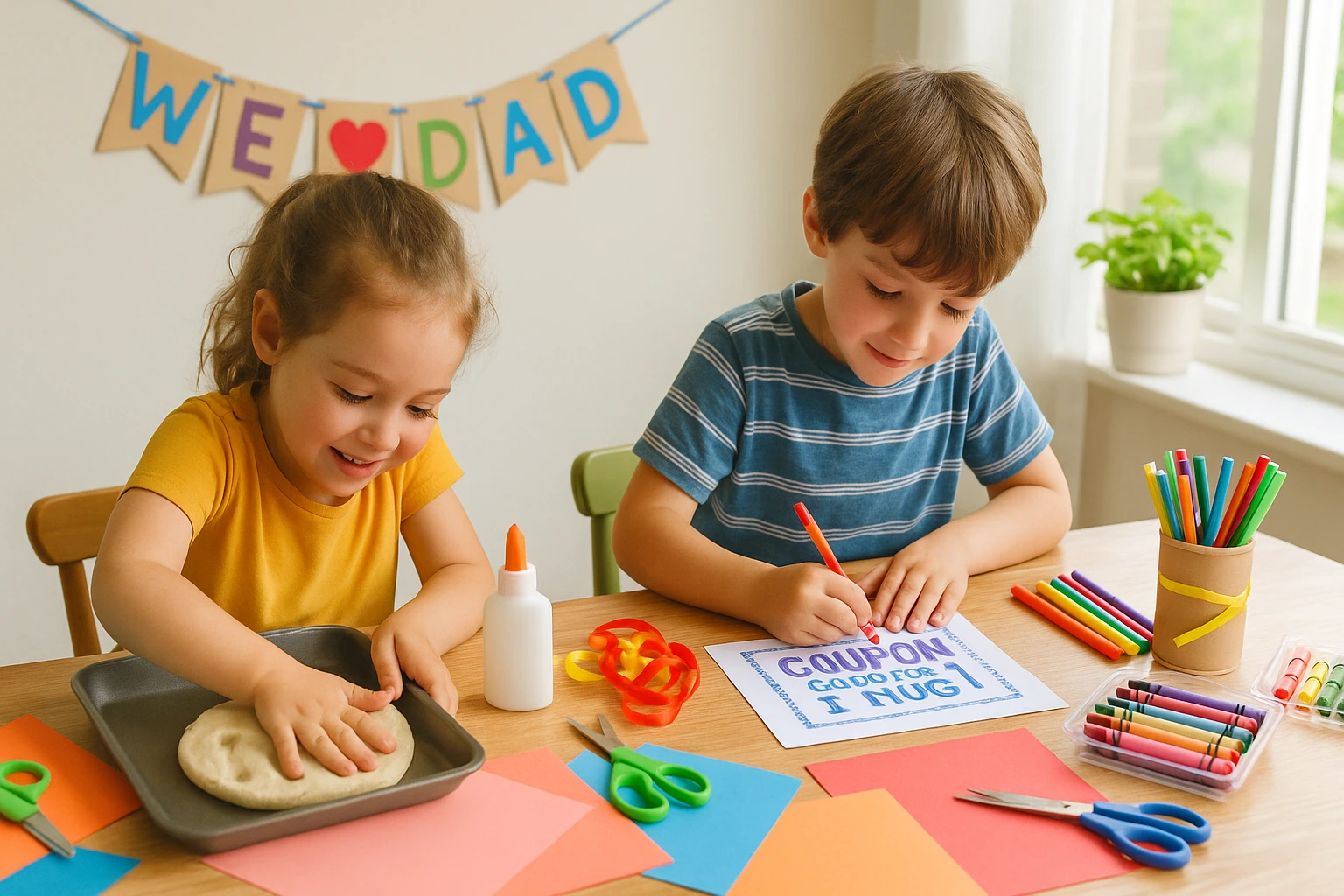
A child-made gift does not need to look store-bought to feel finished. The crooked letter or unexpected color is often the part Dad remembers. The useful goal is a project the child can meaningfully help make—not an adult craft with a child’s name added at the end.
These five Father’s Day projects use paper, cardboard, markers, or one simple fabric item. Choose by the adult step, not the child’s age. A child who dislikes cutting may love drawing; another may want to plan every detail but need help using the hole punch.
Table of Contents
- Choose the Right Father’s Day Project
- Make One of These Five Projects
- Plan the Adult-Only Steps
- Present the Finished Gift
- Fix Common Project Problems
- Frequently Asked Questions
Choose the Right Father’s Day Project
| Project | Main supplies | Child’s main job | Adult step |
|---|---|---|---|
| Super Dad banner | Printed pages, coloring tools, string | Color and arrange the pennants | Cut, punch, and hang securely |
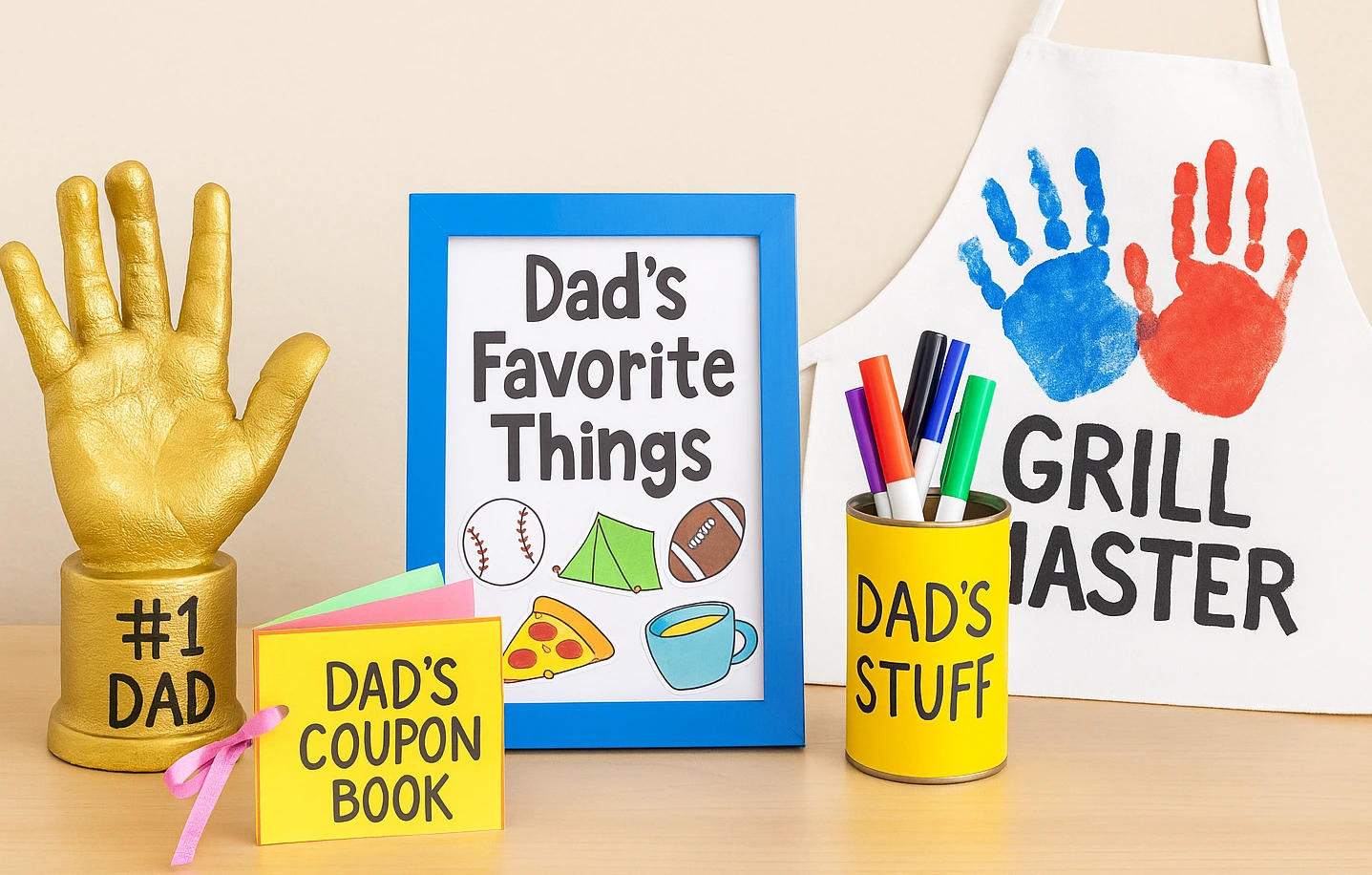
| Coupon booklet | Paper, markers, ribbon or staples | Choose realistic promises and decorate | Fasten the booklet |
| Favorite-things portrait | Cardboard, paper, markers, optional photo | Draw or write what Dad enjoys | Trim the cardboard backing |
| Cardboard desk tray | Shallow box, paper, glue, markers | Cover and label the tray | Trim the box and supervise glue |
| Decorated apron | Plain apron, fabric markers or paint, cardboard | Create the artwork and message | Follow curing or heat-setting directions |
Start with the materials already available and the kind of making the child enjoys. A shorter project they truly participate in will feel more personal than a complicated keepsake they mostly watch someone else complete.
Make One of These Five Father’s Day Projects
1. Printable Super Dad banner
This is the cleanest option when the room needs a decoration and the child wants something to color. The free four-page pack contains a full-color banner and a matching color-it-yourself version.
- Download the printable Super Dad banner.
- Print the full-color pages or the low-ink coloring pages.
- Let the child color the outline version and choose where the lightning bolt, stars, and heart should go.
- Have an adult cut and punch the pennants, then thread them in S-U-P-E-R D-A-D order.
- Hang the banner where the string cannot create a trip or entanglement hazard.
2. A coupon booklet with promises a child can keep
The best coupon is specific, realistic, and actually useful to the recipient. Avoid filling the book with adult-sized chores a child cannot complete safely or independently.
- Cut several paper rectangles or fold small sheets in half.
- Ask the child what Dad enjoys doing with them or what small help they can genuinely offer.
- Write one promise per page, such as “Choose our family movie,” “One extra story together,” “I will help set the table,” or “A giant hug whenever you need one.”
- Add a cover and let the child decorate every coupon.
- Have an adult staple the edge or punch one hole and tie the pages with short ribbon.
3. Dad’s favorite-things portrait
Instead of producing a generic “best dad” frame, make the picture about details the child notices: Dad’s favorite snack, a shared joke, a hobby, a pet, or a place they go together.
- Ask the child to name three things Dad likes and one thing they enjoy doing together.
- Draw those details on paper or arrange them around one printed family photo.
- Add a title such as “Things That Make Dad Smile” or “Our Favorite Things to Do Together.”
- Mount the finished page on a slightly larger piece of sturdy cardboard.
- Add a folded cardboard stand on the back or attach a short hanging loop.
A cardboard backing avoids glass and lets the child decorate the border. An adult should trim thick cardboard with the appropriate tool.
4. A cardboard desk catch-all tray
A shallow box lid or sturdy food-package tray can hold keys, paper clips, coins, or other small desk items. Cardboard is easier to inspect and prepare safely than an opened metal can with a potentially sharp rim.
- Choose a clean, dry, shallow cardboard box or lid with firm corners.
- Have an adult trim loose flaps and check that no staples or sharp edges remain.
- Wrap the outside with plain paper or let the child draw directly on clean cardboard.
- Add a label such as “Dad’s Important Stuff” and one small personal message inside.
- Let glue and marker ink dry completely before placing anything in the tray.
5. A decorated apron
This project works for a dad or father figure who cooks, bakes, grills, paints, gardens, or does another appropriately messy activity. Use a plain apron and decorating products intended for fabric.
- Wash and dry the apron first if the product directions require it.
- Place cardboard inside so color cannot bleed through to the back.
- Sketch the layout on paper before drawing on the fabric.
- Add a short message, names, simple pictures, or hand outlines rather than crowding every part of the apron.
- Let the design cure and have an adult complete any required heat setting exactly as the marker or paint manufacturer directs.
Plan the Adult-Only Steps
Separate adult setup from child creativity. Prepare the safe workspace, then hand the project back instead of quietly finishing every uneven edge.
- Set out only the needed tools. Fewer choices make it easier to begin and easier to clean up.
- Protect the work surface. Use scrap cardboard or washable covering where glue, ink, or fabric paint may transfer.
- Test unfamiliar materials. Try markers, glue, or paint on scrap material before using the final project.
- Plan drying time honestly. A project with wet glue or fabric paint is not a last-minute choice.
- Decide the child’s jobs first. Coloring, choosing words, arranging pieces, and signing are meaningful contributions even when cutting remains adult-only.
Present the Finished Father’s Day Gift
Presentation should support the project rather than hide it under expensive wrapping.
- Banner: hang it before breakfast or use it as the background for a family photo.
- Coupon booklet: place it inside a handmade envelope or tie it with the same ribbon used to fasten the pages.
- Portrait: stand it near Dad’s breakfast place or wrap it in reused brown paper.
- Desk tray: add one useful item Dad already owns rather than buying filler just to make the tray look full.
- Apron: fold it with the artwork facing up and include a small note explaining who designed each part.
Let the child explain one choice when they give the gift: why they used that color, chose that coupon, or drew that memory. The explanation often carries more meaning than another decoration.
Fix Common Father’s Day Project Problems
- The child loses interest: reduce the project to one meaningful job and let an adult handle the setup and cleanup.
- The project looks crowded: choose one title, one main image, and a limited color palette before adding more decorations.
- There is not enough drying time: switch to the coupon booklet, portrait, or full-color banner instead of rushing wet glue or paint.
- You are missing a material: simplify the finish. Cardboard can replace a frame, paper can replace decorative fabric, and drawings can replace photos.
- The adult is taking over: stop correcting cosmetic imperfections and ask the child which part they want help with.
- The gift is for a different father figure: change “Dad” to the person’s name or role on projects with handwritten wording. The Super Dad banner has fixed letters and is not digitally editable.