
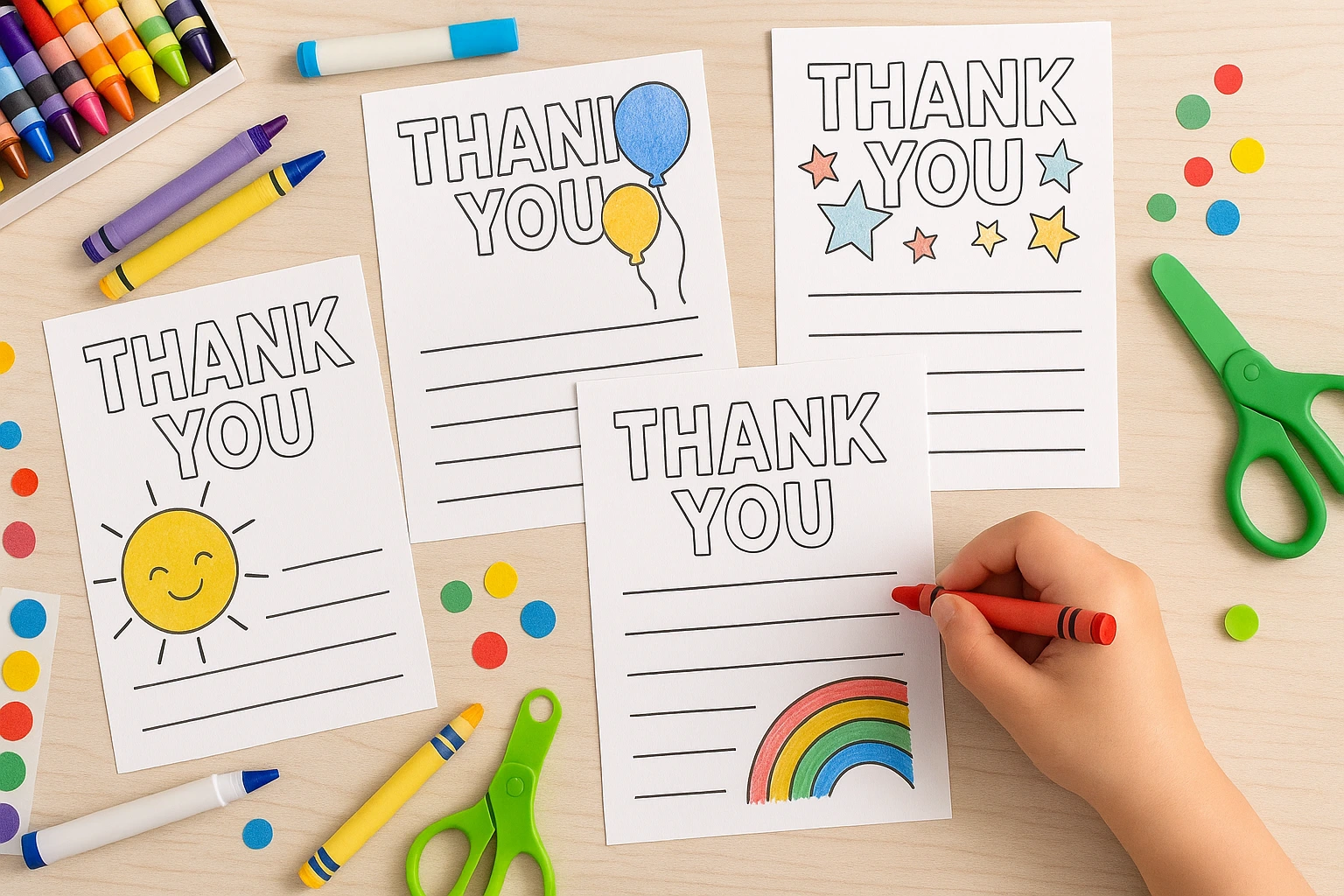
A child can know exactly why they feel grateful and still freeze when it is time to write. The blank page is often harder than the thank-you. A short prompt removes that first obstacle without turning the note into an adult-written speech.
This free two-page PDF includes guided wording for children who need a starting sentence plus an additional page of printable thank-you-note designs. The first page starts the sentence for them. You can then help them add one real detail in their own words.
Download the Kids’ Thank-You Notes PDF
Table of Contents
- What the Printable Includes
- Print the Notes Correctly
- Help a Child Write a Complete Thank-You
- Choose the Right Amount of Writing Support
- Finish and Deliver the Note
- Fix Common Problems
- Frequently Asked Questions
What the Printable Thank-You Notes Include
| PDF detail | What is included |
|---|---|
| Length | Two printable pages |
| Page 1 | Two guided thank-you-note formats with short fill-in prompts |
| Prompt set 1 | Recipient, what the child received, why they love it, and their name |
| Prompt set 2 | Recipient, what the child is thanking them for, and a closing name |
| Page 2 | Additional printable thank-you-note designs |
| Paper setup | A4 portrait, approximately 8.27 by 11.69 inches |
| File type | Fixed PDF; the printed wording is not digitally editable |
The pack does not contain five separate age-based worksheets, and it does not assign one design to a specific age. Choose the page by how much help the child wants today, not by a rigid age label.
Print the Thank-You Notes Correctly
- Open the downloaded PDF. Print the PDF itself rather than the webpage or display image.
- Use A4 paper when available. The file is designed at A4 portrait size.
- Select the page you want. Page 1 contains the guided prompts; page 2 contains the additional designs.
- For A4, choose Actual Size or 100%. Check the print preview before committing multiple sheets.
- For US Letter, choose Fit or Scale to printable area. The design will become slightly smaller, so print one test before preparing several notes.
- Use paper that suits the child’s tools. Standard printer paper is easy to write on; compatible lightweight cardstock creates a sturdier note.
If several notes or designs share one sheet, cut them apart only after the ink has dried. An adult should handle scissors or paper trimmers for young children.
Help a Child Write a Complete Thank-You
A useful thank-you note can be only two or three sentences. What makes it meaningful is one specific detail, not its length.
- Name the person. Start with “Dear Grandma,” “To Uncle Sam,” or the recipient’s preferred name.
- Name the gift or kind action. “Thank you for the puzzle” is clearer than “Thank you for everything.”
- Add one true detail. Say how the child will use it, what they liked, or how the person’s help made them feel.
- Sign the note. Use the child’s name or the closing that feels natural for that relationship.
Simple examples to adapt
- For a gift: “Thank you for the dinosaur book. My favorite page is the one with the huge footprints.”
- For someone’s time: “Thank you for taking me to the park. I loved going down the big slide with you.”
- For help: “Thank you for helping me practice. I felt proud when I could do it by myself.”
- For a party or visit: “Thank you for coming to my party. I was happy we got to play together.”
These are examples, not scripts a child must copy. Ask one concrete question—“What part did you like most?”—and use the answer they actually give.
Choose the Right Amount of Writing Support
| What the child can do today | Helpful adult role | Useful approach |
|---|---|---|
| Draw or dictate | Write down the child’s exact words | Let the child add a picture, mark, or signature |
| Copy a short sentence | Write a model on scrap paper | Keep the sentence short enough to copy comfortably |
| Answer fill-in prompts | Read each prompt aloud if needed | Use page 1 and pause after each blank |
| Write independently | Help brainstorm one specific detail | Use an additional design from page 2 |
| Feels tired or resistant | Reduce the task without removing their voice | Complete one note now and return to the rest later |
Handwriting, spelling, and letter formation do not have to be perfect for the gratitude to be real. Correct only what prevents the recipient from understanding the message, unless writing practice is also the child’s chosen goal.

Finish and Deliver the Note
- Check the recipient’s name. Make sure the note is addressed to the right person.
- Look for one specific detail. If it only says “thanks,” ask one gentle follow-up question.
- Add the child’s name. A signature or recognizable mark completes the note.
- Let wet ink dry. Do this before folding, stacking, or placing the note in an envelope.
- Choose a delivery method. Mail it, hand it over, tuck it into a bag, or leave it somewhere the recipient will find it.
When a child is helping prepare a gift for someone else, the printable gift-tag pack provides a separate place for the recipient’s name while the thank-you note remains focused on gratitude.
Fix Common Thank-You Note Problems
- “I don’t know what to say”: ask what the person gave or did, then ask which part the child remembers most.
- The answer is only one word: turn that word into a sentence without changing the child’s meaning.
- The child cannot write the whole message: let them dictate while an adult writes, then invite them to sign or draw.
- There are several notes to complete: make a short recipient list and finish one at a time over more than one sitting.
- The note prints too large on Letter paper: select Fit or Scale to printable area and check the preview.
- The print is too small on A4: choose Actual Size or 100% and disable unnecessary shrinking.
- Markers bleed through: switch to pencil, colored pencil, or a drier pen after testing the same paper.